Start Now in Minutes!
Just create a ezeep Blue account and connect your printers with our Connector or ezeep Hub to get started.

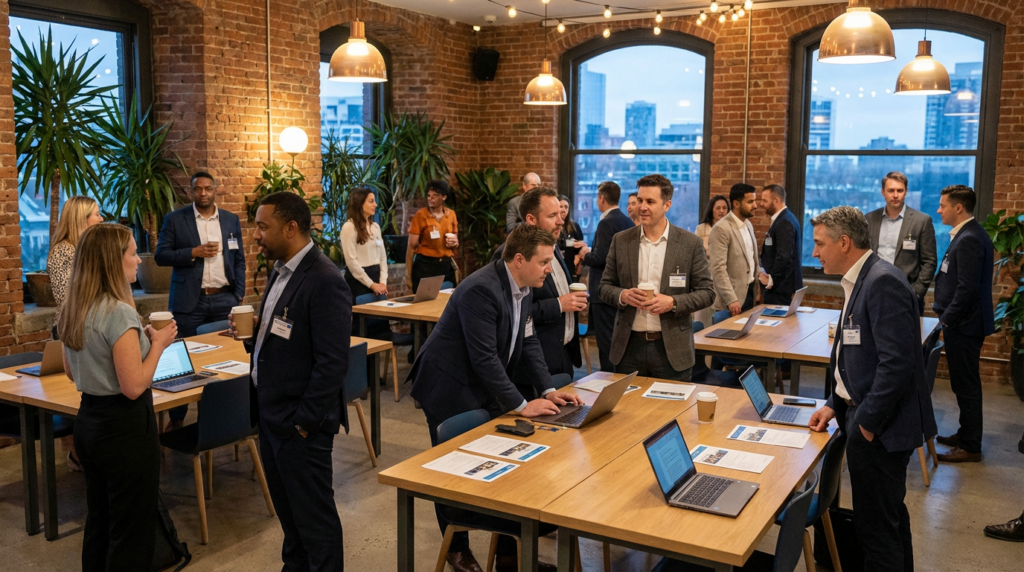
Breakfast meetups, after-work drinks, workshops, or networking evenings feel welcoming, bring energy to the space, and strengthen the community. The problem is that they often still remain in the “nice to have” category. They take time, energy, and budget, without it being clear what they actually deliver.
But events have far more potential than that. When planned the right way, they can do more than just create a good atmosphere. They can directly contribute to occupancy, member retention, and new customer acquisition. What starts as a nice extra idea can become a real revenue driver.
The coworking market has matured. A great location, attractive design, and flexible pricing are important, but today they are often no longer enough to stand out in a lasting way. Many prospects compare offers very carefully. They are not just looking for a desk, but for a place where connections, opportunities, and momentum are created.
This is exactly where events come in. They make the value of a space visible. They bring people together, create reasons to come back, and give prospects a concrete reason to get to know the space in the first place.
Even more importantly, events can have an impact at very different points in the sales process. For example, by
In other words, an event is not just a program item. It can be the start of a predictable customer journey.
A pleasant event can be organized quickly. An effective event has a clear goal.
Anyone who wants to use events as a revenue driver should not start by asking, “What could we host sometime?” Instead, the better question is, “What result do we want to achieve?” From there, almost everything else follows.
A few common goals:
A practical example: A monthly networking event with local business owners may look like a purely community-focused format at first glance. But when it is set up properly, it becomes a funnel: registration, attendance, follow-up, trial day, tour, contract conversation. Suddenly, the event is no longer an end in itself, but part of a system.
To make events more predictable, you do not need a huge event machine. What matters is a simple structure.
This last point in particular is often underestimated. Many spaces know that an event “was well received.” But they do not know whether it generated five leads or none. Anyone who changes that can improve formats much more deliberately and use budgets with far more confidence.
Never underestimate the impact of the atmosphere. A professionally printed agenda on the table, fast Wi-Fi without barriers, a neatly printed attendee list at the entrance, these are the moments when visitors unconsciously decide: This is where I want to work. Tools like ezeep make it easy to handle these details smoothly, whether you need to quickly print name tags, handouts, or feedback forms.
Events can be one of your strongest growth levers, but only if you understand them as part of your overall strategy. Define clear goals, build a simple follow-up system, and measure your results consistently. You do not need to run more events. You need to run them smarter.
Of course, not every event has to generate revenue right away. Community remains a core part of the coworking mindset. But community and business are not mutually exclusive. On the contrary, the strongest spaces achieve both. They organize events that feel good and also work strategically.
That is the difference between random activity and a scalable concept. Anyone who does not view events in isolation, but as part of marketing, the member experience, and operational development, builds a more stable business in the long run.
Anyone who plans more clearly here creates more than atmosphere. They create opportunities for occupancy, retention, and new revenue. That is exactly when events move from “nice to have” to a tool you can truly rely on.